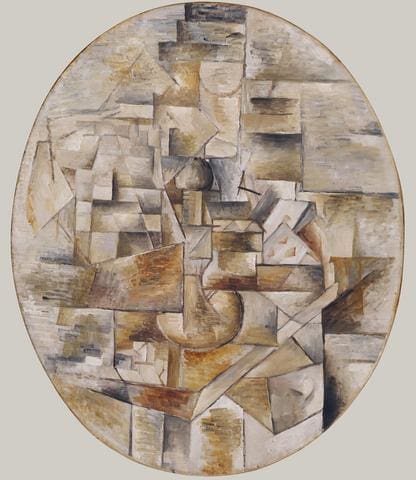
Georges Braque’s "Candlestick and Playing Cards on a Table, 1910": A Masterpiece of "High" Analytic Cubism
Exploring Georges Braque’s "Candlestick and Playing Cards on a Table, 1910"
Georges Braque’s "Candlestick and Playing Cards on a Table, 1910," housed in The Mr. and Mrs. Klaus G. Perls Collection at the Metropolitan Museum of Art, exemplifies the quintessential characteristics of "High" Analytic Cubist painting, a phase that spanned from 1910 to 1912. This masterpiece showcases Braque's innovative approach to visual representation, characterized by the rejection of traditional perspectival space, abstract treatment of volume and space, intersecting planes, and a subdued grisaille palette.
Characteristics of "High" Analytic Cubism:
Braque's painting features mundane naturalistic objects—a candlestick and playing cards—rendered in a fragmented, abstract manner. The canvas's oval shape, a deliberate formal innovation, eliminates empty corners found in rectangular Cubist works, creating a tightly constructed world arranged through an unconventional grid of diagonal lines and curves.
Subtle Visual Cues and Ambiguity:
Despite its illegibility, the painting retains subtle visual cues that prompt viewers to recognize the depicted objects. Elements like the jutting table corner and stylized representations of the candlestick and playing cards offer glimpses of reality amidst abstraction, challenging conventional notions of representation.
Intellectual and Visual Game:
Braque's use of color, characterized by somber earth tones and a cool emotive content, divorces the painting from traditional emotional associations, focusing instead on tensions of space and form. The artist's deliberate brushwork and the visible physicality of the oil medium further emphasize the painting's object-hood, grounding it in materiality.
Avant-Garde Lifestyle and Ideologies:
Renato Poggioli's definition of the avant-garde as a cultivated lifestyle and rejection of stylistic tradition resonates with Braque's artistic approach. Braque's avant-garde tendencies are culturally and aesthetically driven, reflecting his non-conformist disposition rather than political motivations. Through his innovative visual language, Braque offers viewers a window into his artistic mindset and lifestyle.
Conclusion:
"Candlestick and Playing Cards on a Table, 1910" stands as a testament to Georges Braque's pioneering contributions to Cubism and the avant-garde movement. By challenging traditional modes of representation and embracing abstraction, Braque invites viewers to explore new dimensions of visual expression and intellectual inquiry.